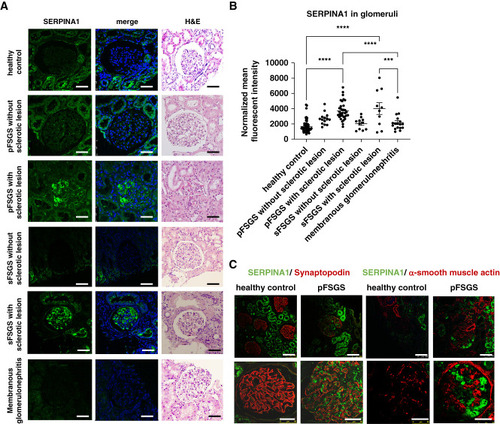
SERPINA1 is increased in sclerotic lesions of FSGS. (A) Representative immunofluorescent staining for SERPINA1 (green) and the merged images together with nuclei DAPI staining (blue) as wells H&E staining of the same glomerulus. Scale bar 75 µm. pFSGS and sFSGS are divided in a group of glomeruli with sclerotic lesions and a group without sclerotic lesions. (B) Quantification of total immunofluorescent signal of SERPINA1 staining in glomeruli of transplant kidneys with no pathology (healthy control), glomeruli with pFSGS or sFSGS with sclerotic lesions and glomeruli of patients with pFSGS or sFSGS without sclerotic lesions in the glomerulus (pFSGS without sclerotic lesions/sFSGS without sclerotic lesions) and membranous GN. All stainings were normalized to background fluorescence. In total 31 biopsies and 145 glomeruli (59 healthy control, 14 pFSGS without sclerotic lesions, 34 pFSGS with sclerotic lesions, 11 sFSGS without sclerotic lesions, 10 sFSGS with sclerotic lesions, and 17 membranous GN) were analyzed. ***P < 0.001, ****P < 0.0001. (C) Immunofluorescent staining for SERPINA1 (green) and synaptopodin (red) on kidney biopsy sections of transplant kidneys with no pathology (healthy control) and glomeruli of patients with pFSGS. Scale bar 100 µm (upper row) and 50 µm (lower row). (D) Immunofluorescent staining for SERPINA1 (green) and α-smooth muscle actin (red) on kidney biopsy sections of transplant kidneys with no pathology (healthy control) and glomeruli of patients with pFSGS. Scale bar 100 µm (upper row) and 50 µm (lower row). DAPI, 4′,6-diamidino-2-phenylindole; H&E, hematoxylin and eosin.
|