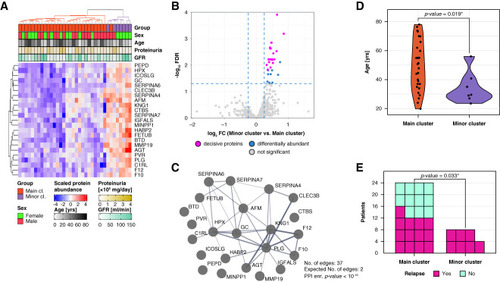
Analysis of pFSGS patients' heterogeneity by subclustering. Heatmap representing the scaled protein abundances (color scale) of all 23 proteins that are decisive to stratify pFSGS subclusters (main pFSGS cluster, minor pFSGS cluster, in rows) in all 37 included pFSGS patients (columns). Top annotations indicate patients' disease group assignment, as well as clinical parameters sex, age, proteinuria, and GFR. (B) Volcano plot representing the abundance differences (x axis, log2 fold change) and significance values (y axis, log10 FDR) for the pairwise comparisons main pFSGS cluster versus minor pFSGS cluster. Blue dots represent proteins assigned as significant in the pairwise comparison whereas magenta dots represent proteins that are decisive to stratify pFSGS subclusters from ANOVA with post hoc testing. (C) PPI from proteins that are decisive to stratify pFSGS subclusters. Nodes represent proteins, whereas edges represent known functional and/or physical interactions. Created with StringDB.18 (D) Violine/dot plot representing the age distribution of patients in the main and minor pFSGS clusters. Significance level was calculated based on Mann–Whitney U test. (E) Waffle chart representing the relapse rate of patients among the main and minor pFSGS clusters. Each rectangle represents one patient. Magenta squares represent patients with a disease relapse, whereas turquoise squares represent nonrelapsing patients. Six patients with unknown relapse status were not included. Significance level was calculated based on Fisher exact test for overrepresentation of relapse patients in one of the groups. *p < 0.05.
|