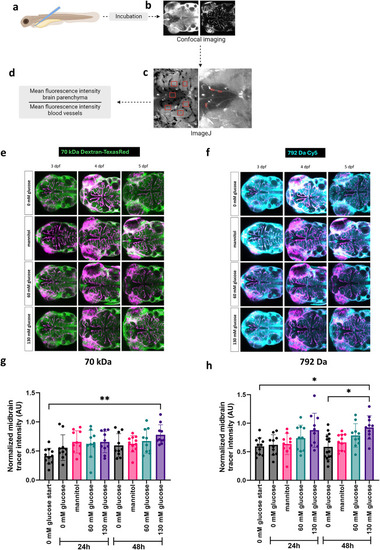
BBB permeability measurements after hyperglycemia in zebrafish larvae. (a-d) Experimental design for the quantification of blood vessel permeability. Created in https://BioRender.com. (a) At 3, 4 and 5 dpf, Tg(fli1:EGFP) zebrafish larvae were injected into the cardiac sac with fluorescent tracers. (b) Confocal microscopy images of a fluorescent tracer (left image) and the fluorescent blood vessels (right image) are shown separately. (c) Fluorescence intensity measurements using ImageJ software are shown. Left image: In the tracer channel, the vasculature (GFP) was subtracted from the tracer fluorescence. Tracer fluorescence was measured in 6 regions of brain parenchyma (red rectangles). Right image: In the tracer channel, the fluorescence intensity was measured at 3 regions inside the lumen (red rectangles). (d) To normalize the fluorescence intensity, the mean fluorescence inside the parenchyma is divided by the fluorescence intensity inside the lumen. Representative maximum intensity projection of a confocal z-stack showing the brain (dorsal view) of Tg(fli1:EGFP) zebrafish injected with (e) 70 kDa Dextran-Texas Red (green) and (f) 792 Da Cy5 (cyan) at 3, 4 and 5 dpf under hyperglycemic conditions (60 mM or 130 mM glucose). 0 mM glucose and 130 mM mannitol were included as controls. Vasculature is shown in magenta. (g, h) Quantification of tracer intensity as measured in the midbrain parenchyma at baseline, after 24 h and 48 h of glucose exposure normalized to luminal tracer intensity, both for (g) 70 kDa Dextran-Texas Red and (h) 792 Da Cy5. n = 10–15 fish per group. Data are represented as mean ± SD. *P < 0.05, **P < 0.01.
|