
Figure 6
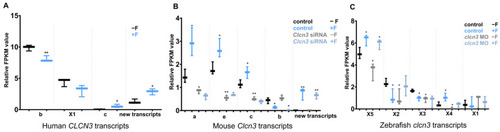
Comparison of fluoride-induced response among ClC-3 transcripts in human HEK 293 cells, mouse ameloblast LS8 cells and zebrafish embryos. (A) Various human CLCN3 transcripts respond differently to fluoride. In untreated HEK 293 cells, transcripts CLCN3b and CLCN3X1 were predominant, whereas CLCN3c and several unreported transcripts were barely detectable. After exposure to 2 mM NaF for 24 h, the levels of CLCN3b and CLCN3X1 were reduced, with the decrease in CLCN3b being statistically significant (p < 0.01). In contrast, the trace amounts of CLCN3c and the previously unreported transcripts were markedly increased. (B) Comparison of different mouse Clcn3 transcripts. Various transcripts exhibited distinct responses to excessive fluoride. The fluoride-induced changes in transcripts a, c, and e were suppressed by Clcn3 siRNA, whereas those in transcript b were not. Excess fluoride also induced the expression of several previously unreported transcripts in both human and murine cell lines. (C) Comparison of different zebrafish clcn3 transcripts. Control and clcn3 morpholino zebrafish larvae were cultured for 48 h in 76 ppm NaCl or 76 ppm NaF. Transcriptome analysis revealed that clcn3 X2–X5 transcript levels were reduced by the clcn3 morpholino. These transcripts also responded differently to fluoride overdose, and the morpholino attenuated several of the fluoride-induced changes (X5, X2, X4). *: p < 0.05; **: p < 0.01. |