
Figure 2
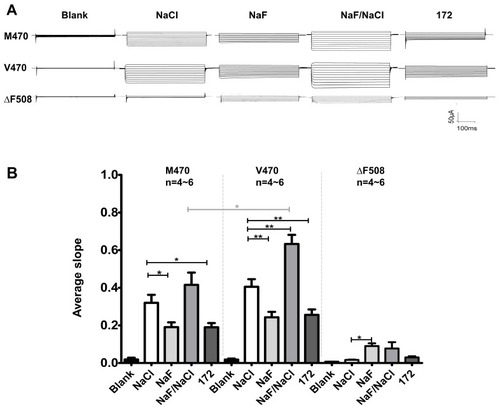
Chloride and fluoride currents of different CFTR genotypes in Xenopus oocytes. (A) Representative current traces of single-channel recordings of M470, V470 or ∆F508 CFTR obtained at different holding potentials in the sequence indicated. Blank: without activating cocktail containing 10 μM forskolin and 1 mM IBMX; other four groups: with activating cocktail. NaCl: ND96 solution containing 96 mM NaCl; NaF: ND96 solution containing 96 mM NaF; NaF/NaCl: transition from 96 mM NaF state to 96 mM NaCl state; 172: ND96 solution with CFTRinh172. (B) Comparison of currents in the above RNA-injected oocytes. The average slope was calculated to reflect the current–voltage (I-V) relationships from −160 mV to +40 mV. Both M470 and V470 showed various membrane currents under NaCl and NaF stimulating conditions. Their difference was found when 96 mM NaF was replaced by 96 mM NaCl, and the larger membrane currents were found in V470 group. CFTR (inh)-172 may inhibit the current as 96 mM NaF did. ∆F508 did not show any obvious currents in the regular ND96 current, but fluoride stimulus increased weak current. n = 4~6. *: p < 0.05; **: p < 0.01. |