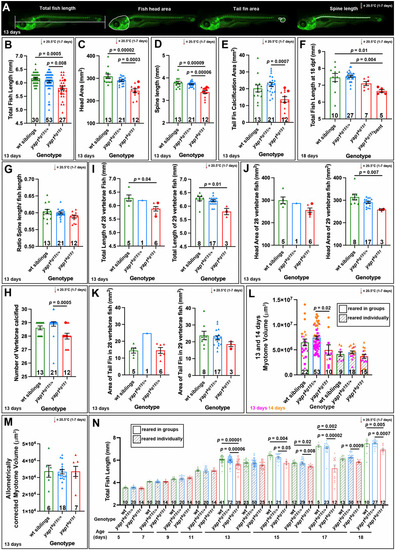
Yap1 is required for normal larval growth in a group.
Yap1kg151/+ in-crosses were reared at 20.5°C from 70% epiboly to 7 days (5 dpf-equivalent) and then at 26.5°C until 13 days (11 dpf-equivalent) or 18 days (16 dpf-equivalent). Larvae were stained with calcein. (A) Schematics of measurements made (white). (B-G,H,M,N) Total fish length (B,F,N), head area (C), spine length (D), tail fin calcified area (E), Spine length divided by fish length ratio (G), number of calcified vertebrae (H) and myotome 17 volume/total fish length cubed (M). (I,J,K) After segregation into groups containing 28 or 29 calcified vertebrae, total fish length (I) and head area (J), but not tail calcified area (K), were reduced in yap1 mutants compared to wt siblings. (L) Volume of myotome 17 in 13-14 day fish reared in group nursery environment (clear bars) or individually with unlimited food (striped bars). (N) Length of fish at 5, 7, 9, 11 and 13, 15, 17 and 18 days reared individually with unlimited food (striped bars) or in group nursery environment (clear bars). Statistics: Kruskal-Wallis tests with Dunn’s post hoc comparisons. Green bars wt siblings, blue bars yap1kg151/+ siblings red bars yap1kg151. Red circle symbols represent curved spine fish (B-F,H-K). Symbol shape represents different lays/experiments (L,N). Number of fish analysed is indicated on columns.
|