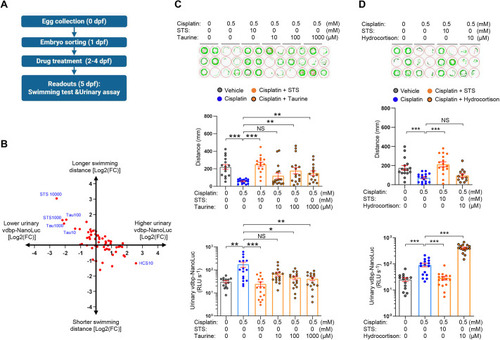
Use of the vdbp-NanoLuc reporter system for nephroprotective drug screening. (A) Experimental protocol used in drug screening with transgenic ½vdbp-NanoLuc larvae to identify antioxidants able to rescue the cisplatin nephrotoxicity. (B) Graphical overview of screening data showing the log2-fold change (FC) in urinary vdbp-NanoLuc, reflecting LMW proteinuria (x-axis) and swimming distance (y -axis). STS at 10 mM (STS10000) completely rescues cisplatin toxicity as evidenced by restoration of swimming distance and reduction in urinary vdbp-NanoLuc luciferase activity. Urinary vdbp-NanoLuc luciferase activity was partially rescued by co-treatment with 100 µM and 1000 µM taurine (Tau100 and Tau1000, respectively), but luciferase activity was increased with co-incubation with 10 µM hydrocortisone (HCS). Blue, drug name and concentration (µM). (C) Behavioral analysis and urinary analysis for 5 dpf zebrafish larvae incubated with vehicle, cisplatin alone, or co-incubated with cisplatin and 10 mM STS or taurine at different concentrations for 24 h. n=16. Overnight urine was collected and analyzed using luminometry. n=16. (D) Behavioral analysis and urinary analysis for larvae incubated with vehicle, cisplatin alone, or co-incubated with cisplatin and 10 mM STS or 10 µM HCS for 24 h. Swimming capacity was not further inhibited by HCS co-treatment; however, urinary vdbp-NanoLuc luciferase activity was highly increased by HCS co-treatment. n=16. Plotted data represent mean±s.e.m. Nonparametric Mann–Whitney test, *P<0.05, **P<0.01, ***P<0.001. NS, non-significant.
|