|
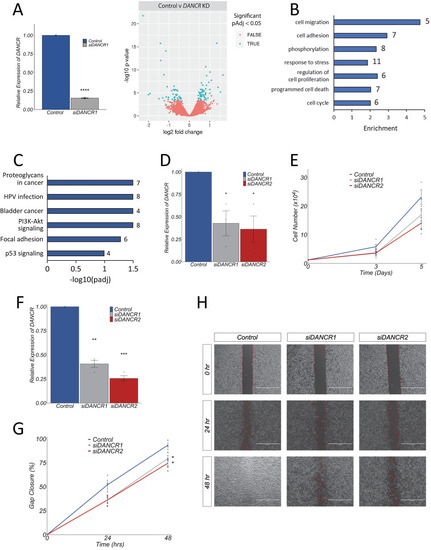
DANCR promotes human melanoma cell proliferation and migration. (A, B, C)DANCR target genes are enriched for regulators of cancer associated processes and pathways including cell proliferation, migration and death. (A) siRNA mediated DANCR depletion in SK-MEL-28 cells induces statistically significant changes in the expression of 98 genes compared to a non-targeting control (DESeq2 padj<=0.05; log2FoldChange>=0). GO enrichment (B) and KEGG pathway (C) analysis of the DANCR regulated gene set was performed. Representative significantly enriched categories (FDR 5%) and pathways (FDR 10%) are shown. The number of genes found in each category are indicated. (D, E, F, G, H)DANCR promotes melanoma cell proliferation and migration. DANCR levels were depleted in SK-MEL-28 cells using two independent siRNAs. Three days later DANCR expression was determined using RT-qPCR (D, F) and proliferation (E) or wound healing (G, H) assays set up. For proliferation analysis, cells were seeded in a 6-well plate and the total number of cells were counted at days 0, 3 and 5 (E). For wound healing assays, cells were first treated with mitomycin-C to block cell proliferation and migration was determined using Ibidi chambers. The gap was imaged at 0, 24 and 48 hours and percent gap closure calculated using the ImageJ Wound Healing plugin (G, H). Statistical analysis was performed at the 48-hour time point. For all RT-qPCR experiments, expression changes are shown relative to a non-targeting negative control siRNA (set at 1). POLII was used as a reference gene. All results presented as mean + /- SEM., n = 3. Two-tailed two sample t-test p < 0.05*, p < 0.01**, p < 0.001***. Individual dots represent separate biological replicates.
|