FIGURE SUMMARY
Title

A gal4 insertion in the rx3 locus as a tool for visualization and manipulation of eye fated cells in zebrafish

Authors
Vásquez-Ramírez, M.J., Villanueva, A., Lira, E., Nahuelpan, D., Kawakami, K., Valdivia, L.E.
Source
Full text @ Biol. Res.

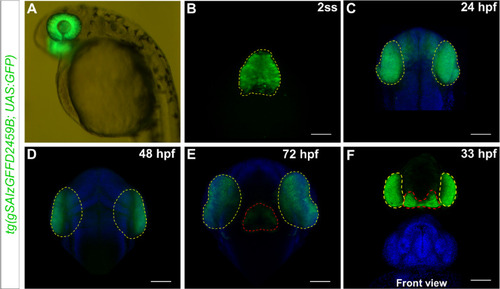
tg(gSAIzGFFD2459B)-driven GFP is expressed in embryonic eyes and diencephalon. A Lateral overview of GFP expression in the eyes of a 36 hpf embryo. B GFP is first visible in the eye field of embryos at the 2-somite stage embryo (dorsal view; anterior is up). C Expression becomes restricted to the optic cups at 24 hpf (dorsal view). D Expression in the eyes is maintained at 48 hpf, while at 72 hpf (E), GFP expression is also observed in the hypothalamus (dorsal view). F A front view at 33 hpf shows the expression pattern in the eyes and hypothalamus. Nuclei are stained with DAPI (blue). Yellow dashed lines outline the GFP expression domains in the eye regions, while red dashed lines mark the hypothalamus of the embryo. Scale bar = 100 µm

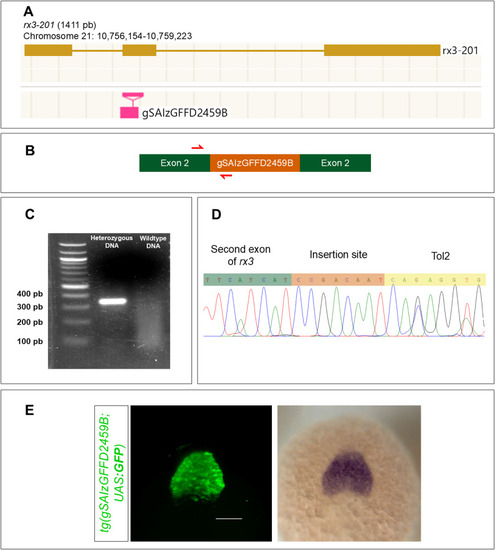
tg(gSAIzGFFD2459B) is inserted in the second exon of the rx3 gene. A Screenshot of the zTrap database showing the insertion of the tg(gSAIzGFFD2459B) transgene in the rx3 locus. B Graphic diagram representing the insertion, specifically in the second exon of rx3. Red arrows represent the primers used to validate the insertion. C Gel electrophoresis of PCR products amplified from the genomic DNA of gal4 heterozygous (GFP-positive) embryos shows a 343 bp band (n = 7), whereas no amplification is observed from wild-type embryo genomic DNA. D Chromatogram of the sequencing of the PCR product from the insertion validation. The green section corresponds to a part of the rx3 second exon, the orange section represents the plasmid insertion site of the transgenic line, and the yellow section shows a part of the Tol2 arm, corresponding to the insertion of the transgene. E The expression patterns of the transgene (green, left) and rx3 (purple, right) in 2-somite stage embryos are similar. The embryos shown in panel E are distinct individuals but are at the same developmental stage. Scale bar = 100 µm

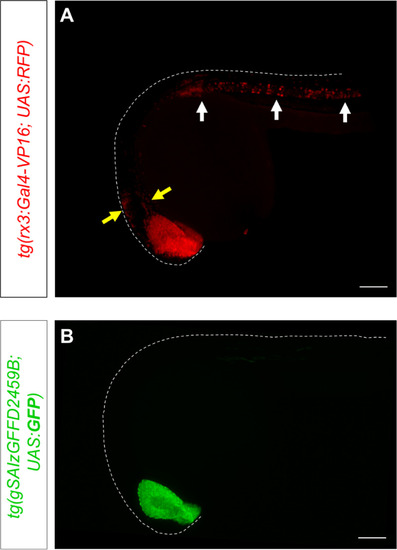
The tg(gSAIzGFFD2459B) transgenic line more faithfully recapitulates endogenous rx3 gene expression. A Image of a 26 hpf embryo from the tg(rx3:Gal4-VP16) reporter line driving RFP expression in the eyes (red), as well as ectopic expression in the brain (yellow arrows) and the notochord (white arrows) (n = 8). B In contrast, a lateral view of a tg(gSAIzGFFD2459B) embryo at the same stage shows GFP expression exclusively in the eyes, with no ectopic expression (n = 9). Scale bar = 100 µm

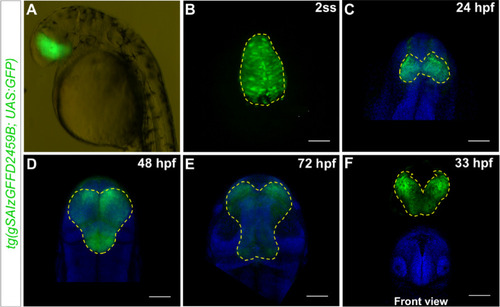
Homozygous tg(gSAIzGFFD2459B) embryos display anophthalmia. A Lateral overview of the expression of GFP in a 36 hpf eyeless embryo. B At the 2-somite stage, GFP-labelled rx3 + cells are observed in the eye field (dorsal view; anterior is up). CE The GFP-labelled cells destined to form the eye structures remain confined in the prosencephalon. GFP expression is maintained in this territory at the 48 hpf (C) and 72 hpf (E) stages, with no visible eyes or optic structures forming. F A front view at 33 hpf shows a cluster of GFP-positive cells retained in the brain. Scale bar = 100 µm

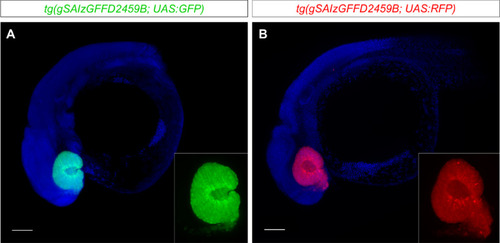
tg(gSAIzGFFD2459B) can be combined with other UAS-based transgenic reporters. A UAS-driven GFP expression in a 30 hpf embryo (n = 20). B UAS-driven RFP expression in a 30 hpf embryo, showing an identical expression pattern in the same territories as observed in A (n = 5). Scale bar = 100 µm

Acknowledgments
This image is the copyrighted work of the attributed author or publisher, and ZFIN has permission only to display this image to its users. Additional permissions should be obtained from the applicable author or publisher of the image. Full text @ Biol. Res.