|
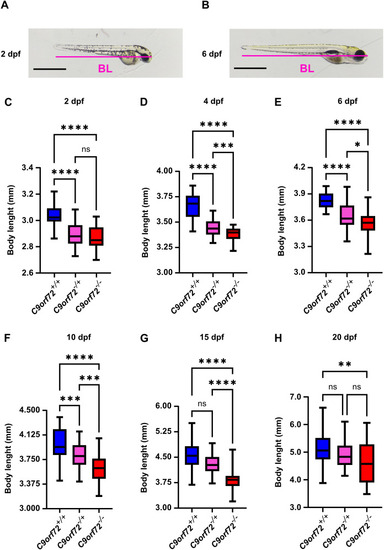
C9orf72 knockout results in persistent size reduction during late embryonic and larval stages. (A) Schematic representation of a C9orf72+/+ zebrafish larvae body length (BL) measurement at 2 and 4 days post-fertilization (dpf). (B) Schematic representation of a C9orf72+/+ specimen BL measurement from 6 dpf onward. (C-H) Body length analysis at 2, 4, 6, 10, 15, and 20 dpf of C9orf72+/+, C9orf72-/+, and C9orf72-/- specimens. (C) Significant size reduction observed for C9orf72-/+ and C9orf72-/- specimens compared to C9orf72+/+ controls at 2 dpf. (D-F) The C9orf72-/+ and C9orf72-/- specimens remain significantly smaller than C9orf72+/+ controls at 4, 6, and 10 dpf, with C9orf72-/- specimens also significantly shorter than C9orf72-/+ at these time points. (G) At 15 dpf, C9orf72-/- specimens are significantly smaller than both C9orf72+/+ and C9orf72-/+. (H) At 20 dpf, C9orf72-/- specimens stay significantly smaller than C9orf72+/+ controls. Statistical tests: ordinary one-way ANOVA with Tukey#39;s multiple comparisons post-hoc test (C, F); Welch and Brown-Forsythe ANOVA with Dunnett#39;s T3 multiple comparisons post-hoc test (D, E); Kruskal-Wallis test with Dunn#39;s multiple comparisons post-hoc test (G, H). **** p < 0.0001, *** p ≤ 0.001, ** p < 0.01, * p ≤ 0.05, and NS p > 0.05. Boxplot extremities indicate maximum and minimum values; box limits show the interquartile range (central 50%), and the central line marks the median value. n = 35–45 individual larvae per genotype. Scale bars = 1 mm.
|