
Fig. 4
- ID
- ZDB-FIG-230904-16
- Publication
- McArthur et al., 2023 - Early development of respiratory motor circuits in larval zebrafish (Danio rerio)
- Other Figures
- All Figure Page
- Back to All Figure Page
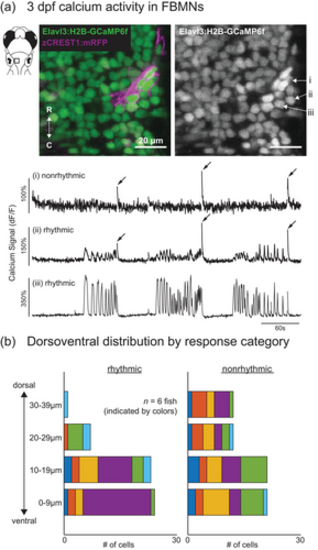
Calcium imaging demonstrates that facial branchiomotor neurons (FBMNs) exhibit both rhythmic and nonrhythmic activity at 3 days postfertilization (dpf), and reveals dorsoventral topography by activity pattern. (a) At 3 dpf, some FBMNs (i) exhibit only large, infrequent (“nonrhythmic”) calcium transients associated with attempted whole-body movements (indicated by arrows), while other FBMNs (ii and iii) exhibit bouts of additional burst activity (“rhythmic”). Sampling interval = 295 ms. (b) At 3 dpf, rhythmic FBMNs are located almost exclusively in the ventral half of the facial motor nucleus (0–19 μm from the ventral-most FBMN, for each fish), while nonrhythmic FBMNs are found throughout its dorsoventral extent. Response category (rhythmic vs. nonrhythmic) is a significant predictor of dorsoventral position (n = 6 fish; mixed effects linear model: p = .0035). Bars of the same color indicate FBMNs imaged in the same fish. Dorsoventral position is measured with respect to the approximate plane of the bilateral facial motor nerve within the hindbrain. |