
Fig. 1
- ID
- ZDB-FIG-221216-35
- Publication
- Conith et al., 2022 - The Evolution of Feeding Mechanics in the Danioninae, or Why Giant Danios Don't Suck Like Zebrafish
- Other Figures
- All Figure Page
- Back to All Figure Page
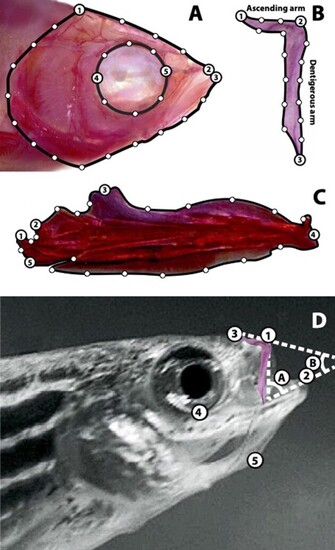
Shape and motion data collection. A. Homologous anatomical landmarks (LM) used in skull shape analyses: (1) most posterio–dorsal point on the parietal bone; (2) anterior tip of the premaxilla; (3) anterior tip of the dentary; (4) posterior point on the eye socket in line with the parasphenoid; and (5) anterior point on the eye socket in line with the parasphenoid. Semilandmarks were evenly spaced along the outline of the skull between LM 1 and 2, 1 and 3, 4 and 5, and 5 and 4. B. Homologous anatomical LM used in premaxilla shape analyses: (1) tip of the ascending arm; (2) anterior tip of the premaxilla (see panel D for the location of the premaxilla within the skull); (3) and tip of the dentigerous arm. Semilandmarks were evenly spaced along the outline of the premaxilla between LM 1 and 2, 2 and 3, and 1 and 3. C. Homologous anatomical LM used in mandible shape analyses: (1) posterio–dorsal extent of the lower jaw joint (quadrate–articular joint); (2) anterio–dorsal extent of the lower jaw joint; (3) tip of the primordial process of the articular; (4) anterior tip of the dentary; and (5) posterior tip of the angular. Semilandmarks were evenly spaced along the outline of the mandible between LM 1 and 2, 2 and 3, 3 and 4, 4 and 5, and 1 and 5. D. LM and angles used in motion analyses: (1) anterior tip of the premaxilla; (2) anterior tip of the dentary; (3) a stationary point on the dorsal surface of the anterior head; (4) ventral-most point of the eye socked; (5) anterior tip of the hyoid series (basihyal); (A) gape angle; and (B) angle of jaw-protrusion direction. |