
Fig. 4
- ID
- ZDB-IMAGE-251022-61
- Publication
- Tran et al., 2025 - Redundant and novel functions of scube genes during zebrafish development
- All Figures
- Figures for Tran et al., 2025
|
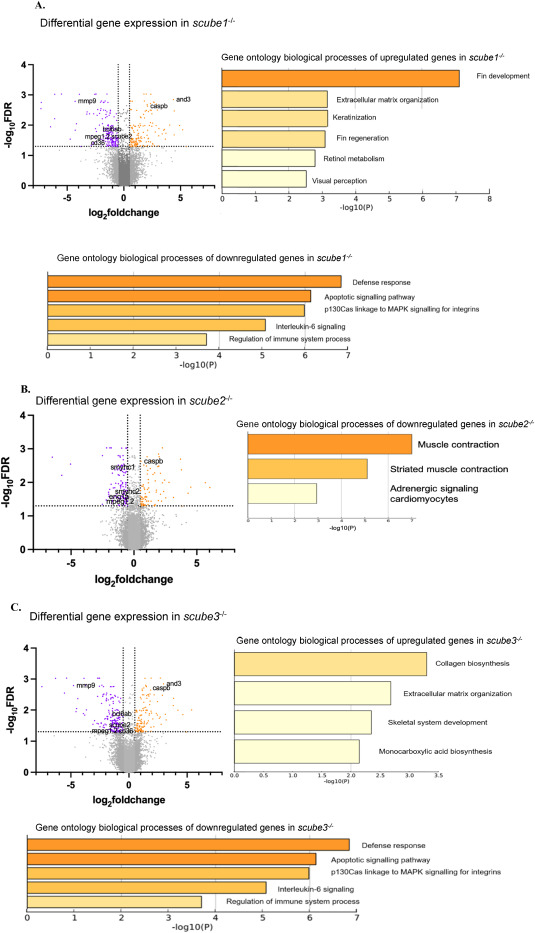
Fig. 4 RNA seq analysis of scube1−/−, scube2−/−and scube3−/−embryos at 30 hpf. (A) RNA sequencing of scube1 mutants revealed upregulation of processes related to fin development and regeneration, extracellular matrix formation, keratinisation, and eye development. Conversely, there is a downregulation of processes associated with the immune response system (response to bacterium, interleukin-6 signalling, response to wounding, platelet degranulation Herpes infection), apoptotic signalling and response to estrogen. (B) RNA sequencing of scube2−/− zebrafish mutants indicated downregulation of processes linked to muscle contraction and adrenergic signalling in cardiomyocytes. (C) RNA sequencing of scube3−/− zebrafish mutants revealed upregulation of processes related to collagen synthesis, extracellular matrix formation, and skeletal system development. Conversely, downregulated processes include those involved in the defence response system, specifically interleukin-6 signalling and the regulation of immune system processes. Yellow bars indicate lower significance or enrichment, while orange bars indicate higher values. FDR cutoff = 0.05. Volcano plots displaying differential gene expression between scube mutants and wild-type zebrafish. The x-axis shows log2 fold change in gene expression, and the y-axis indicates - log10 FDR. Each point represents an individual gene. Genes with absolute log2 fold change greater than 0.5 and FDR less than 0.05 are highlighted: upregulated genes are orange, downregulated genes are purple, and non-significant genes are grey.
Reprinted from Developmental Biology, 528, Tran, Q.D., Mirkovic, I., Miles, L.B., Berger, J., Wood, A.J., Ruparelia, A.A., Shehni, S.A., Currie, P.D., Redundant and novel functions of scube genes during zebrafish development, 79-90, Copyright (2025) with permission from Elsevier. Full text @ Dev. Biol.