FIGURE SUMMARY
Title

Investigating the Role of Zebrafish Retinoschisin Homologs Rs1a and Rs1b During Retinal Development

Authors
van der Veen, I., Koster, C., Brink, J.B.T., Kamermans, M., Boon, C.J.F.
Source
Full text @ Dev. Neurobiol.

The alignments of the protein sequences of Rs1a (NP_001003438.1) and Rs1b (NP_001004655.1) with human orthologue RS1 (hRS1 (NP_000321.1)) show a high degree of homology between the three proteins. The alignment was performed using the multiple sequence alignment program Clustal Omega (version 1.2.2.) using default parameters. Rs1a and Rs1b have a similarity score to each other of 72.5% and to hRS1, respectively, 81.7% and 71.5%. Amino acids with identical physiochemical properties are taken into account for the determination of similarity. (*) denotes identical residues, conversed residues are indicated with (:), and similar residues with (.). RS1 = retinoschisin. In the sequence of hRS1, the protein's domains are indicated. Red = N‐terminal signal peptide and C‐terminal segment, orange = RS domain, green = discoidin domain.

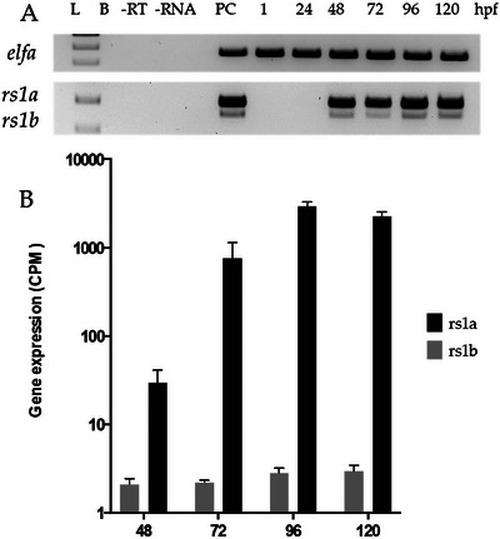
rs1a and rs1b are expressed in the developing zebrafish eye from 48 hpf onwards. Gene expression was assessed at 1, 24, 48, 72, 96, and 120 hpf. A: The expression of reference gene elongating factor alpha (elfa) was consistent across all samples. Gene expressions of rs1a and rs1b were first detectable at 48 hpf and were detected throughout 120 hpf. B. Expression levels, as measured by RNA sequencing, of rs1a and rs1b. Hpf = hours post‐fertilization, B = blank,—RT = cDNA synthesis negative control without reverse transcriptase, ‐RNA = cDNA synthesis negative control without input RNA, PC = positive control with adult zebrafish eye cDNA, 1 = 1 hpf, 24 = 24 hpf, 72 = 72 hpf, 96 = 96 hpf, 120 = 120 hpf.

EXPRESSION / LABELING:
Genes:
Fish:
Anatomical Term:
Stage Range: 4-cell to Day 5

The spatiotemporal overview of retinoschisin (Rs1) protein presence during the first five days of retinal development shows that Rs1 protein presence is first detected at 48 hpf and increases in intensity and spatial distribution up to 120 hpf. Cryosections were incubated with primary antibodies overnight at 4°C. At least 3 biological replicates were examined per timepoint. A: No positive immunostaining of Rs1 was observed within the first 24 h of retinal development. B: At 48 h, Rs1 protein presence was first observed in this experiment in low levels in the ganglion cell layer (GCL). C: At 60 hpf, a weak signal was detected in the GCL, the inner plexiform layer (IPL), and the outer nuclear layer (ONL) D‐E. The intensity of Rs1 immunostaining continued to increase throughout 72 (D), 96 (E), and 120 (F) hpf. G. Co‐staining of Rs1 and cone arrestin (Arr3) demonstrated that Rs1 surrounds the developing outer segments at 120 hpf. F. Rs1 presence was quantified per retinal layer and normalized to total Rs1 signal per sample. Data represent mean percentage of Rs1 signal per layer (± standard error of the mean). A shift in Rs1 localization is observed from predominately INL at 72 hpf toward increasing IPL and GCL contribution at later stages. Hpf = hours post fertilization, Rs1 = retinoschisin, Arr3 = cone arrestin, DAPI = 4′,6‐diamidino‐2‐phenylindole.

The morpholino oligos (MO) for retinoschisin (RS1) homologs rs1a and rs1b were designed to block the translation of the mRNAs into proteins, and were developed alongside a control oligo (SC). A‐B: The mRNA sequence of the MO binding region was confirmed on Sanger sequencing for rs1a (A1) and rs1b (B1) to ensure perfect binding. A1‐B1: the first 50 nucleotides of the Danio Rerio rs1a (A1) and rs1b (B1) mRNA. The MO binding region is indicated in bold green text. Red indicates the start codon. A3‐B3: ‘'5’ to ‘'3’ sequence of the MO targeting rs1a (A3) and rs1b (B3) and their untargeted control oligos containing the same base pair ratios.

Morpholino oligo‐mediated knockdown does not influence gross eye size and morphology or overall embryo development but does eliminate Rs1 protein production at 72 hpf. A: Gross eye morphology and size at 72 hpf were imaged in the sagittal plane of a representative uninjected control (CTRL) (A1), translation‐blocking morpholino oligo (MO)‐injected (A2), and scrambled control oligo (SC)‐injected (A3) embryos under a dissection microscope. Some variations in eye shape were observed in MO‐ and SC‐injected larvae (A2, A3), but no microphthalmia. The scale bars represent 100 µM. B: At 72 hpf, there were no readily discernible differences in the developmental stage between uninjected (B1) MO‐injected (B2) and SC‐injected (B3) siblings. Deformations associated with oligo overdose were very rare at the chosen oligo concentrations (50 ng/µL; less than 1% in 100 injections). C. Rs1 protein presence was observed at 72 hpf in SC larvae (C1) but not in MO‐injected larvae (C2) using IHC. The scale bars represent 50 µm. WT = wild‐type, MO = morpholino‐oligo injected, SC = control injected, hpf = hours post‐fertilization.

EXPRESSION / LABELING:
Antibody:
Fish:
Knockdown Reagents:
Anatomical Term:
Stage: Protruding-mouth
PHENOTYPE:
Fish:
Knockdown Reagents:
Observed In:
Stage: Protruding-mouth

Delivery of translation‐blocking morpholino oligos targeting rs1a and rs1b mRNA results in significant downregulation of axon guidance and adherens/anchoring junctions at 72 h post‐fertilization. Following RNA sequencing, Kyoto Encyclopedia of Genes and Genomes (KEGG) pathway, and Gene ontology (GO) enrichment analyses were performed. A: the top 5 most significantly upregulated GO terms for biological processes (BP; blue bars), cellular components (CC; green bars), and molecular function (MF; red bars). n refers to the number of DEGs mapped to the term. B: the top 5 most significantly downregulated GO terms for BP (blue), CC (green), and MF (red). n refers to the number of DEGs mapped to the term. C: all significantly upregulated (green bars) and downregulated (red bars) KEGG pathways. n refers to the number of DEGs mapped to the pathway. UP = upregulated, DOWN = downregulated. Padj = adjusted p‐value.

Delivery of translation‐blocking morpholino oligos (MO) targeting rs1a and rs1b mRNA results in significant downregulation of visual perception and camera‐type eye development at 96 h post‐fertilization (hpf), as well as impaired photoreceptor development. Following RNA sequencing, gene ontology (GO) enrichment analyses were performed. A: All significantly downregulated GO terms for biological processes (BP; blue bars) and molecular function (MF; red bars). No terms for cellular components were significantly enriched in differentially expressed genes (DEGs). n refers to the number of DEGs mapped to the term. B: All upregulated GO terms for cellular components (CC; green bars). MF and BP did not yield terms significantly enriched in DEGs. n refers to the number of DEGs mapped to the term. C: Heatmap of phototransduction‐related genes (derived from Kyoto Encyclopedia of Genes and Genomes [KEGG] pathway). Red and green colors indicate respectively down‐ and upregulation of the genes in MO compared to scrambled (SC). The scale ranges from strongly downregulated (fold change 0.18) to slightly upregulated (fold change 2.0). D: Immunofluorescent staining of blue cone pigment small‐wavelength sensitive opsin (OPN1SW) in 4 and 5 day‐old SC‐ and MO‐injected zebrafish. Padj = adjusted p‐value. Dpf = days post‐fertilization.

Acknowledgments
This image is the copyrighted work of the attributed author or publisher, and ZFIN has permission only to display this image to its users. Additional permissions should be obtained from the applicable author or publisher of the image. Full text @ Dev. Neurobiol.