
Figure 5.
- ID
- ZDB-IMAGE-260509-20
- Publication
- Gillotay et al., 2026 - The role of Nrf2 in thyroid maturation and hormone synthesis in vertebrate models
- All Figures
- Figures for Gillotay et al., 2026
|
Figure 5.
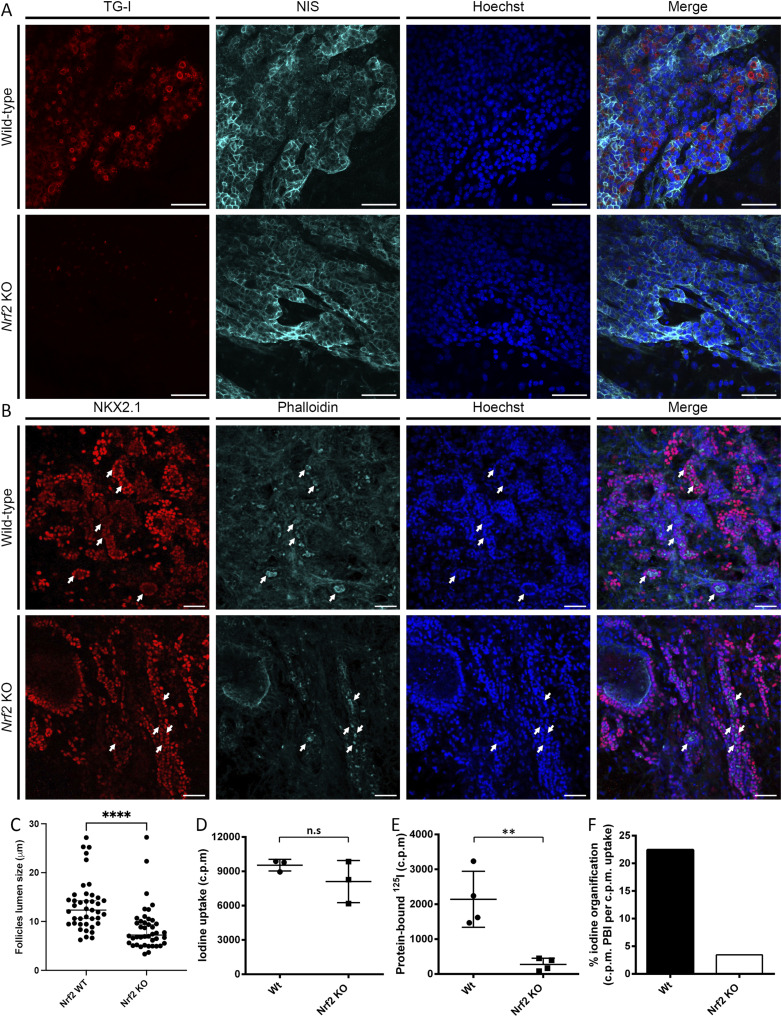
Loss of Nrf2 impairs thyroid function in mESC-derived thyroid follicles.
Characterization of mESC-derived thyroid organoids’ function reveals the critical need for functional Nrf2 for thyroid hormone synthesis. (A) Confocal imaging after immunofluorescence of WT and Nrf2 KO organoids after 22 d of differentiation. Samples were marked for Tg-I (red) and Nis (cyan). Nuclei were labeled using Hoechst (blue). Scale bars: 100 μM. (B) Confocal imaging after immunofluorescence of WT and Nrf2 KO organoids after 22 d of differentiation. Samples were marked for Nkx2.1 (red) and phalloidin (cyan). Nuclei were labeled using Hoechst (Blue). Follicles are indicated by arrows. Scale bars: 100 μm. (C) Thyroid organoid follicle size assessment after 22 d of differentiation. For each condition, samples were labeled using phalloidin staining and 40 follicles were analyzed using Zen software. The median follicle size is 12.34 and 7.22 μm for Nrf2 Wt and Nrf2 KO organoid, respectively. Statistical analysis was performed using the Mann–Whitney test. The asterisks denote significant differences between conditions: ****P < 0.0001. (D, E, F) Functional organification assay revealed an equivalent ability of Nrf2 KO organoids to 125I uptake (D) but reduced protein-bound 125I fraction in Nrf2 KO organoids (E), which results in a lower percentage of cells with capacity of 125I organification (F). Statistical analysis was performed using a t test. The asterisks denote significant differences between conditions: **P < 0.01. “n.s”, no significant difference.