
|
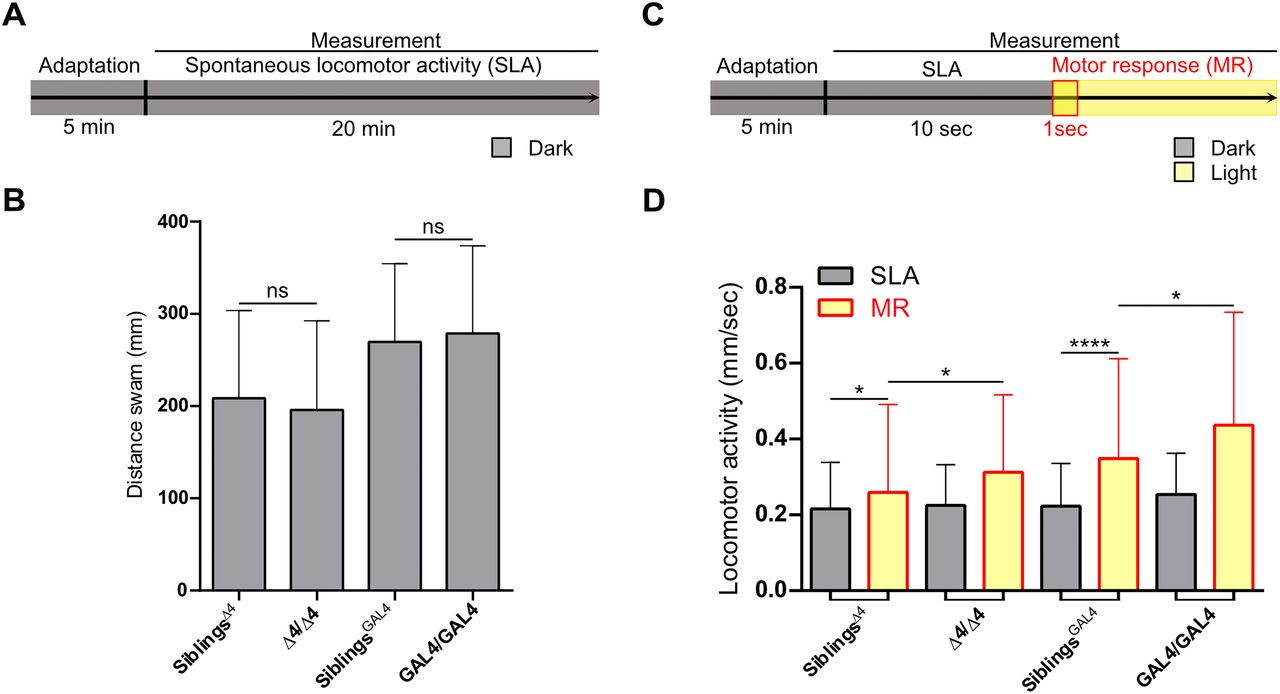
Fig. 8 Gpr85-KO impacts larval light-induced motor response. A, Schematic representation of the experimental setup for assessing spontaneous locomotor activity. B, Quantification of the distance swum by 6 dpf Gpr85-KO larvae compared with siblings over 20 min in the dark (gpr85Δ4/Δ4, n = 69 vs siblings, n = 210; p = 0.36; and gpr85GAL4/GAL4, n = 77, vs siblings, n = 190; p = 0.94; ns, not significant; M–W U tests). C, Schematic representation of the experimental setup for measuring light-induced motor responses. The motor response was recorded within the first second following light onset. D, The motor response was observed in controls as a significant increase in the distance swum following light onset (n = 210 siblings of gpr85Δ4/Δ4 mutants; dark vs motor response; *p = 0.02; n = 247 siblings of gpr85GAL4/GAL4 mutants, dark vs motor response; ****p < 0.0001; Wilcoxon matched-paired signed–rank tests). The motor response was significantly more pronounced in gpr85-deficient animals compared with controls (n = 80 gpr85Δ4/Δ4 mutants vs siblings; *p = 0.015; n = 83 gpr85GAL4/GAL4 mutants vs siblings, *p = 0.011; M–W U tests). SLA, spontaneous locomotor activity; SR, motor response. Data are presented as mean ± SD (B, D).